
When Conversion Bridge sends data to Google Analytics 4, it automatically matches each event to one of Google's recommended event names. This is why Google Analytics custom labels are not used — your data works with GA4's built-in reporting tools right out of the box.
However, you may notice that GA4 groups all events of the same type together. For example, all form submissions appear as a single generate_lead event. If you only have one form on your site, this is fine. But if you have multiple forms, you probably want to see each one separately.
The good news is that Conversion Bridge sends detailed data with every event, including the form's unique ID and its name. You can use this data to create custom events in GA4 that separate your forms (or any other events) into individual entries.
For everything else Conversion Bridge sends with an event, see what data is sent with an event.
Step 1: Create a Custom Dimension
Before you can filter events by form, you need to tell GA4 about those data fields.
- In Google Analytics, go to Admin → Custom Definitions
- Click the Create custom dimension button
- Enter
Form IDas the Dimension Name - Select
form_idfrom the Event Parameter dropdown - Click Save
- (Optional) Repeat to add a second dimension. Enter
Form Nameas the name and selectform_nameas the event parameter
Note: Conversion Bridge sends the form's ID and name under two sets of parameter names, so you may see all four in the dropdown. form_id and form_name are Google's own names for form data and are the better choice for anything new. id and title are the original names, still sent so that reports built on them keep working. Either pair gives you the same values, and the screenshot below shows the id version.
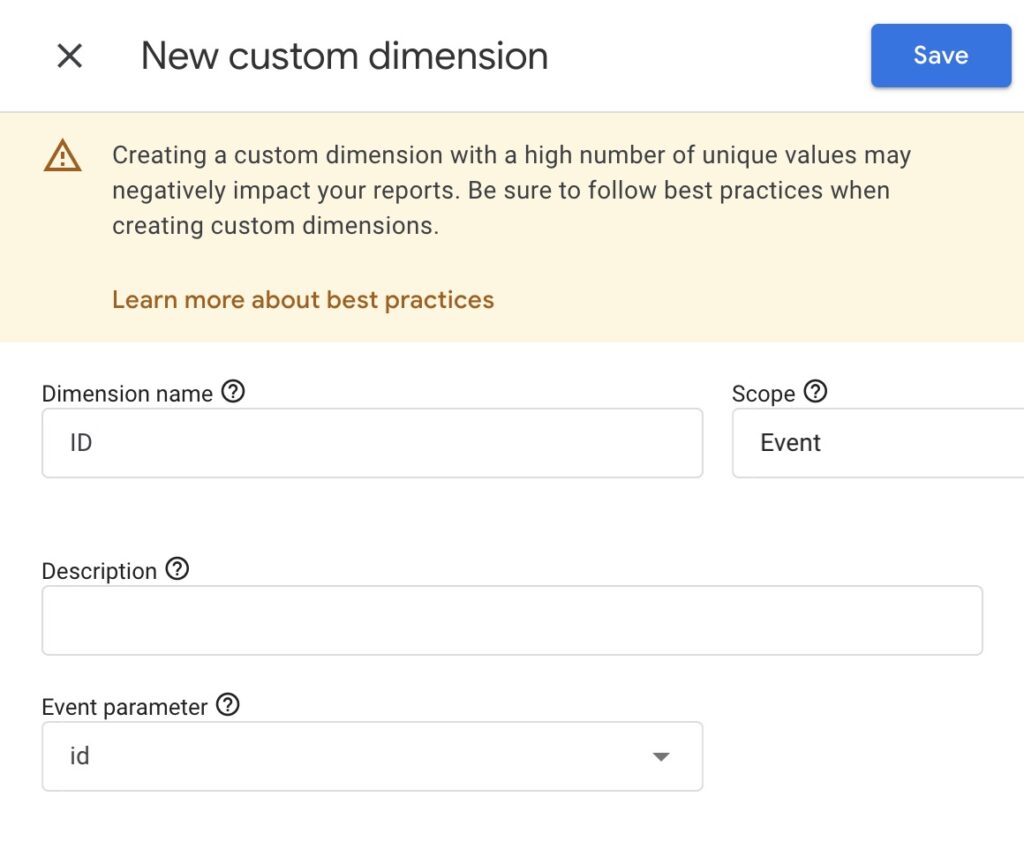
Creating a custom dimension in Google Analytics
Step 2: Create a Custom Event
Now you can create a new event that filters for a specific form.
- In Google Analytics, go to Admin → Events
- Click the Create event button
- Click Create
- Enter an Event Name — this must be all lowercase with no spaces (for example,
contact_form) - Under Matching conditions, set event_name equal to
generate_lead - Click Add condition
- Set the Parameter to
form_id(orid) and the Value to the unique ID of your form
The form ID will depend on your form plugin. Check your form plugin's settings to find the ID for the form you want to track.
If your site was set up before generate_lead became the default, your form events are still named form_submit. Use that name in step 5 instead. See Form Submit Event Name.
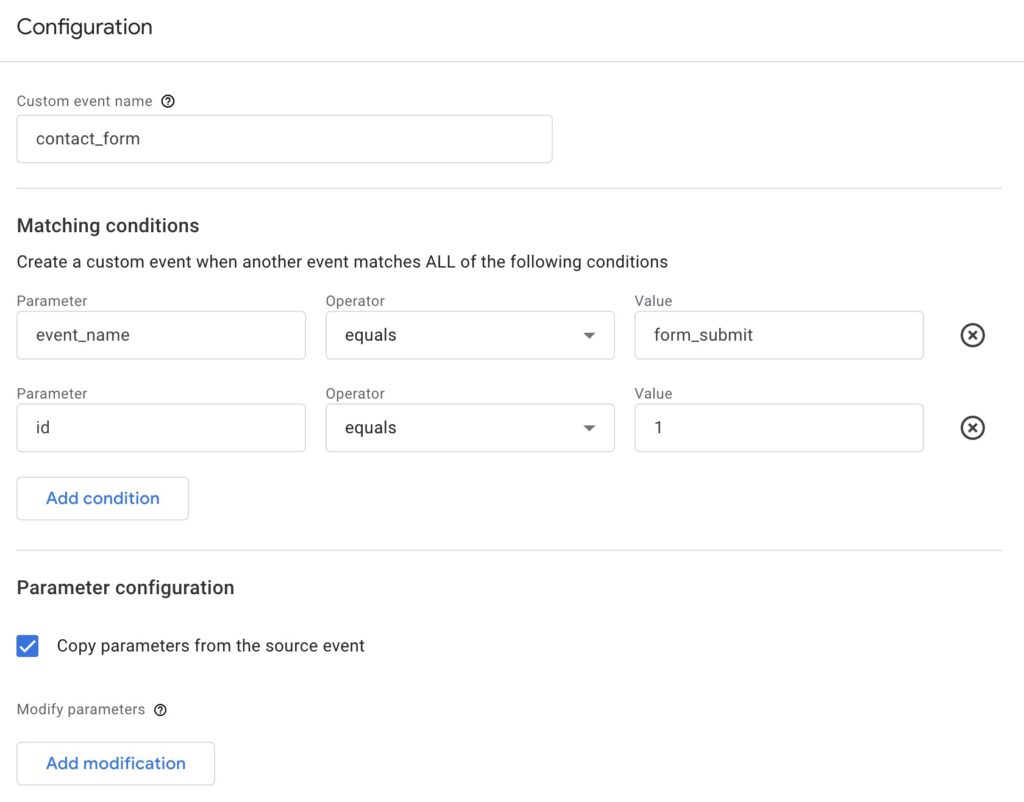
Creating a custom event filtered by form ID
Note: Your new custom event may not appear right away. Submit a test form to trigger the event, then check the Realtime report to see it. It can take up to 48 hours for new events to appear in standard reports.

New "contact_form" event appearing in the Realtime report
Step 3 (Optional): Mark as a Key Event
If your new custom event is important to your site's success, you should mark it as a Key Event. Google Analytics gives Key Events special treatment, including dedicated columns and extra reporting features.
To mark an event as a key event:
- In Google Analytics, go to Admin → Key Events
- Click the New key event button
- Enter the name of your event (for example,
contact_form)
You can also mark events as key events from the Admin → Events page by toggling the key event switch next to any event that has started tracking.
Automatic Custom Dimensions with OAuth
If you connected Google Analytics to Conversion Bridge using the OAuth method, Conversion Bridge can automatically create custom dimensions in your GA4 property. This means you may not need to manually create the dimensions described in Step 1, since they may already be set up for you.
Conversion Bridge automatically creates custom dimensions for:
- Pageview properties you enable in settings (like author, category, tags, post type, and more)
- User properties sent by your plugin integrations (like membership plans)
These dimensions are created automatically when you:
- First connect via OAuth
- Enable new properties and save your settings
- Update the plugin (any missing dimensions are added)
To learn more, see the Custom Dimensions section of the Google Analytics documentation.